Schedule a Visit

Whatever you're looking for, I can help. Schedule a one-to-one with the form to the left, or you can contact me directly:

By phone:
07825 599 340

By email:

stuart@stuartdowning.com


8 years ago · · 0 comments

Seven Ways To Relax That Still Serve Your Purpose

How do you relax? Quite often we can spend many hours of the week browsing social media or watching TV. Whilst this is not the worst ways you could be spending your time, it’s not the most productive either. For those who are high-performers and want to achieve in life, relaxing can be hard, it can make you feel a sense of guilt or shame. Highly conscientious people still need to relax, and there are plenty of productive ways we can learn to relax that still serve our purpose in life.

Reading

Reading educational or fictional books allows us to abstract and leave our minds, just for a little bit. Expand your knowledge means you are spending your time in a fulfilling and useful manner, sparking creative thoughts and stretching your imagination.

If you read a book a week in your specialism, you’ll have read a full degree worth of information within just one year. Within just five years, you’d be one of the most educated people in the world in your field.

Though not everyone needs to read a book a week, trying one a month would be a great start.

Listening to Podcasts

Audiobooks and podcasts within your particular area of interest is a great way to spend your downtime. Whether just for education on a subject of great interest, or to learn new skills and knowledge to push you forward in your career, a lot of my highly focused and high-earning clients choose Audible as a great way to learn, giving them to flexibility to listen to audio around their busy schedules (particularly whilst travelling or at the gym).

Meditation

Take a room in your home, give yourself some space. Get away from any distracting sounds. Breathe quietly in and out through the nose, while focusing on your goals and creating a vision for your future.

Sound cliché? That’s because it works. Meditation has many health benefits, both physical and mental. Practicing it daily can become an extremely productive part of your routine.

Writing

Take notes on your thoughts and feelings, but also keep track of your goals and how you’ve worked towards them.

At the beginning of your day, write down positive affirmations that help you visualise your future success. At the end of each day, write a short reflection on how you felt about the day, what you did to achieve your long-term goals and anything you may have learned.

Writing allows us to express our desires and articulate ourselves clearly. The power of that cannot be underestimated.

Exercise

If you practice exercising every day and don’t feel better after six months, I’d be surprised.

Stimulating both the mind and body, anyone who has ever been into fitness and exercise would most definitely agree an early morning exercise is by far the best way to start the day!

Family Time

Are you spending enough time with your family? I would highly doubt it.

Take away the smartphones, the time spent eating your family meals and watching TV. How much quality time do you spend actually speaking to each other and interacting with your family?

Put more thought into the time you spend with your family and how you regulate your time spent with family members. It’s precious.

Planning Your Future

Set goals and dream big. Why not spend your pastime thinking about your future and planning your legacy? What do you want to achieve? This can be a creative, stimulating task that allows you to embrace your conscious thought.

Do you want to spend your time more productively? Get in touch to speak how I could help you reorganise your life to become more efficient.

8 years ago · · 0 comments

Four Ways To Ascribe Positive Meaning To Your Life

You will have horrific tragedies in your life. There will be illness, death and misery around you. How will you handle it?

As we face the suffering of life, it’s often useful to find ways we can attribute meaning to our life that gives us the way forward and paves a path of light in the darkness we can often clearly see in the world.

Your Possibilities

What can you achieve? What does the future hold? The possibilities are truly endless, and capitalizing on the time you have left on this planet to achieve your dreams can be one of the most fulfilling life journey.

There are two ways you can be fixated in life; a fixed mindset or a growth mindset

If you have a growth mindset, you will see life for the possibilities and options that are available to you. And when you conjure this frame of mind, you can become who it is you want to be.

Your Family

How you live affects not only your life, but those around you. Anyone reading this with children will particularly relate to this, but it also extends to other areas of your family too – sisters, brothers, parents, grandparents, cousins, we all have those people who are close to us. To most people, family can be their most precious and sacred treasure.

Life can often become busy and if you are missing out on your family for other areas of your life, you may be feeling a lack of meaning.

Your Community

If you truly got your act together and structured your life to the point that you can adequately take care of yourself, your family and you can become secure within society, then why not take the next step?

Providing money to a charity is fine, but there is not better satisfaction that volunteering your time to a cause.

Find something you are passionate about, and pursue a greater cause. How can you better the community with your actions?

Your Legacy

The ultimate motivation technique.

What will you be known for when you die? Who will take about you, and what will they say? They are important questions to anyone who seeks to have a legacy and be known for something.

Thinking about death can be uncomfortable, but taking this perspective allows us to see the bigger picture. As time elapses we will inevitably pass away.

What will you leave behind? Will you leave behind sorrow and grievance due to a life of suffering or joy as you lived out your dreams in a life of meaning and virtue?

There is always a choice, you do control your own destiny. Often it’s only the successful people that like to admit it.

What will you be known for? As a life coach, I work with people who strive for excellence in their every day lives. Do you want to achieve greatness? Get in touch to find out how I could help you on your journey.

8 years ago · · 0 comments

How A Life Coach Can Help You Achieve Your Potential

We all feel lost and unmotivated at some point in our lives. Life coaches aren’t some elusive, omnipotent beings that have the ultimate knowledge. We are therapists that listen intently to your current situation and help you conceptualise how you could become more satisfied with your life.

There are many ways that I can work with people, and it’s all on an individualistic basis. Some people literally have one thing in mind, they want to stop smoking or stop a certain behaviour. Others are have become lost in a life absent of any long-term aims or goals, simply seeking new purpose and meaning in their lives.

A life coach should work on an individualistic basis. Everyone requires a different approach, and I have worked with people to assist them in solving a wide range of problems including overcoming depression and anxiety, battling addiction to boosting their confidence for sports and performance therapy.

There are some fundamental ways that I help all of them in very similar ways, which I wanted to share with you today.

Redefining your life purpose

What are you working towards? What are your long-term goals? What is your life purpose?

As you introduce yourself, we slowly start to discuss your life purpose. We go beyond listening to just the content of what you are saying, but what you actually want to convey.

We discuss core issues of your life that you want to change and areas of growth. We discuss deep areas of your life, touching on your life meaning, your personal growth and development. We discuss personal issues that bring you outside of your comfort zone.

This helps redefine and reinforce your purpose and keeps you motivated to work towards your goal.

Develop a clear vision

What do you want? Where do you want to go? Where do you see yourself in ten years? As a life coach, it’s my job to bring together a vision for the future you are looking to build.

Challenging your limitations and thought patterns by asking the right questions to evoke new levels of thinking, bringing to your attention different perspectives (the bigger picture) and allowing you to conceptualise your future, with a vision that is realistic, attainable and worth the sacrifice.

Developing a clear vision for your future is vital to anyone who is looking for the ability to take control of their life, their surroundings and provide the best for themselves and their loved ones.

Recognising your unconscious motives

Why is it you do what you do? What are the motives behind your behaviour? Have you got hidden intentions?

The simple answer is that it’s the habits you’ve instilled into your daily routine through repetitive action over long periods of time.

The absolute truth is that, we only have theories and concepts of how the mind works, and there are many different perceptions of your motives.

Working with a specialist who has studied those theories, from psychological theories from Carl Rogers, Carl Yung, Sigmund Freud, to Erikson hypnotherapy and personal development training from the great works in that field over the last hundred years, it can only be of advantage, right?

This helps develop a more thorough understanding of your motives, and even better than that analyse the underlying reasons of your behaviour and work together to change your thought patterns and ultimate behaviour and consequence.

Positive outsider influence

We are truly institutionalised throughout our lives. A necessary evil, school and later the workplace becomes our grounds of conformity and obedience. This becomes our social contract, we slowly become integrated into society, inevitably robbing us of our individuality whilst simultaneously giving us access to an infinite amount of possibilities in an extremely well-functioning societal construct we have in the Western world.

It has many advantages, access to education and having a clear structure within society allows us to function with minimal amounts of stress and anxiety. There is another side to the coin. Could this somehow cause us to become reliant on someone (or something) holding us accountable (a parent, a teacher and later a manager or boss)?

An outside influence that is working in the interests of your growth and development, holding you accountable for your actions and ensuring you are working towards your goals? It can be priceless.

I’ve helped people battle addiction and build better lives for themselves.

I’ve helped people build to confidence to take on new challenges, such as public speaking or within their career.

I’ve helped people create a life they only dream of, step by step at a time.

Could I help you? Are you looking for someone to help you take the next step? Someone who can push you to go further? Give me a call today for a free phone consultation on 07825599340.

8 years ago · · 0 comments

Setting Goals: A Mindset To Success

The only way to set yourself up for success over the long-term? Clearly define your goals and ensure that working towards them becomes the focal point of your life.

As a life coach, it would make sense that I promote goal setting. But I don’t simply promote goal setting. I promote goal setting that provides you with a real purpose. Goals that are well thought through. Goals with meaning. What are you looking to achieve? Even better, why do you want to achieve those specific goals?

If your goals are going to motivate you, they’ll have to be goals that frighten you. Goals that bring you out of your comfort zone, just by thinking about them. Helping your motivation levels, giving you a purpose, providing you with responsibility and a reason to carry on when times get hard, goals are extremely important for our mental and spiritual health, and I wanted to share some tips on how you can remain focused on them and create for yourself a mindset that attracts success and growth.

Visualise your future

Working towards meaningful goals is always hard work. It is paramount you have a vision of your life that would justify the sacrifice involved in chasing your dreams.

Visualise your future. A month, a year, a decade. What does it look like? Set the scene. Where are you? What are you doing? Think over scenarios in your mind.

Build a picture of where you want to be, and don’t worry about why. You will sort that out as you start working towards the dream.

Write your goals daily

Keep motivated by getting your goals written down. If you are wanting to be completely committed, writing them daily have worked wonders for many of my clients.

There’s power to taking pen to paper. Writing your goals down will help motivate you to brainstorm ideas on how you can achieve those goals.

Develop a long-term plan

Having a goal without a plan is like having carriage without an horse. You won’t get far.

Set yourself up for long-term success with a thoroughly thought out plan on how you will achieve your goals.

Hold faith and handle the burden

Achieving your goal is going to mean taking on the responsibility to live the life that you once dreamed of.

For those who think success is about sitting in a chair and smoking cigars, they’re sadly mistaken. Highly successful people hold the responsibility of not only themselves but often the lives of many others, and this means that there are ripples of consequences with every decision they make.

Take on the responsibility and hold faith in yourself at every obstacle. Do what it takes to achieve your goal and positive influence the lives of others with your action.

Commit and take action daily

Set goals and targets for every day, and work towards them. Stretch yourself, but don’t make them too exhausting.

You’re better to do two hours per day than try to work or learn something new for ten hours straight. Our brains are hardwired for a long-term perspective, we need it to feel fulfilled. Whatever your goal is, commit to the long-term and work towards achieving the goal in increments.

Do you want to set yourself up for success? Let’s work together to set you the right goals and put a plan in place to change your life for the better. Give me a call on 07825599340.

8 years ago · · 0 comments

Self-Awareness: Tips For Understanding Your Personality Type

Your personality type is a huge determining factor when it comes to how you interact with other people and the world around you. We have developed an excellent understanding of what characterises human beings, and the five-factor model is a great example of the knowledge we have of human traits.

The theory uses five broad dimensions to describe the human personality and psyche, which have been defined as openness to experience, agreeableness, neuroticism, conscientiousness and extraversion.

Understanding your personality helps you become incredibly more self-aware as an individual, preparing you well to structure your life in a way that helps you overcome your weaknesses and make the most of your strengths. It may also give you some more understanding into the motives of your behaviours.

How does the big five model characterise our personalities and explain our distinct differences?

Openness to experience

How open to new experiences are you? One of the traits is openness to experience, which defines how you react to new circumstances.

Those who are open to experience, it is said you’re curious rather than cautious. It’s sometimes said those who are more open to experience can be perceived as unpredictable or to be lacking focus, though it’s not all bad. There is also evidence to suggest those who are high in openness will be more interested in self-actualization by seeking out more intense experiences. This trait has been highly linked to intelligence (those high in openness appreciate the intellect much more and tend to seek more creative paths such as becoming a writer, artist or musician.

If you are less open to experience, you may be more conservative and consistent in your approach. Those who are more open to experience may be more spontaneous in their ideas and express themselves more creatively, they are interested in the discussion of ideas and intellectual discussion.

Learning how open to experience you are will allow you to consider how you make decisions. If you’re too spontaneous, you may want to put more thought into your decisions, whereas if you aren’t very open to experience you may want to consider how rigid you are in your thoughts and behaviour.

Conscientiousness

Have you often been described as easy-going or careless? Or perhaps people have called you controlling?

If you aren’t very high in conscientiousness, you are more flexible and spontaneous, which is seen as unreliability. If you’re a conscientious individual, you will be very orderly, self-disciplined and ensure there is a plan in your approach, which come across as stubborn or obsessive.

Conscientiousness is split into “industriousness” and “orderliness.” When looking at this trait, you may want to look at how serious you take your obligations, particularly those you have with other people. Are you too engaged, or do you often let people down too much?

Agreeableness

Do you go along with the crowd, or do you tend to defend your own position more?

People who are agreeable are seen to be kind and warm, they are empathetic by nature. The opposite could be said for those who are disagreeable.

There are lower-limit traits such as trust, compliance, modesty and straightforwardness, which make up how agreeable you are. Do you tend to hold you own ground, or do you go with the crowd?

Highly agreeable people can get themselves involved in the wrong situations quite easily, whereas highly disagreeable people may repel people due to their perceived aggressive nature. Think about how agreeable you are, and how that influences your social interactions.

Extraversion

This trait refers to the energy and how much you feel positive emotion. It’s very much defined by your assertiveness, sociability and how you are stimulated by the company of others.

Those who are extraverts are likely to be perceived as attention seekers or too dominating, and those who are low in extraversion (often referred to as introverts) are likely to be more reserved and reflective, which can be perceived as self-absorbed or aloof.

How much do you enjoy the company of other people? This will help you understand how extraverted you are. Understanding this will allow you to deepen your relationships with others tremendously, being more flexible in your approach to how extraverted you can become (or holding yourself back a little as an extravert).

Neuroticism

How sensitive are you to negative emotions? Neurotic people tend to be more prone to psychological stress, as they experience unpleasant emotions much stronger.

Anger, anxiety, depression and vulnerability are feelings we all come across in our lives. Your neuroticism defines how strongly you feel those emotions.

Those who are high in neuroticism tend to be more prone to being offended, which can make you a dynamic individual who is highly concerned for the needs of yourself and those around you but can be perceived as insecure. Those who are less neurotic tend to be seen in a positive light with their emotional stability, though can also be perceived as being particularly unconcerned.

It must also be noted that those with higher neuroticism tend to have less stable mental health.

Think about how harshly you respond to negative emotion. Are you easily upset, or are you seen as emotionally numb? These are either of the extremes, analyse where you sit in the spectrum.

There are many other models that try to explain personality, and it’s a forever evolving field of research. We don’t fully understand how dynamic we truly are as human beings, and the limits of our abilities are untold.

How does understanding your personality type help you? There are some distinct ways that I feel you can become a better functioning and more stable person by further understanding your personality type:

  • The choices you make within your career
  • Increase your self-awareness and emotional stability
  • Improve your relationships with other people
  • Make a change to the way you react to negative (or positive) emotion
  • Understand the reasons behind your behaviour
  • Take more responsibility for your own thought patterns and behaviours

Admit to yourself who are. Become comfortable in your own skin, and act with confidence knowing that you are unique in every way. Do you want to further your understanding of yourself and become more confident? Are you finding it hard to come to terms with your personality and how that influences how you react to the world around you? Get in touch for a free confidential phone call on 07825599340.

8 years ago · · 0 comments

Long-Term Perspective: The Journey To Success

How can you continue to strive for excellence in the face of constant struggles? How can you sacrifice the present for the future? How can you take responsibility for your own circumstances and make your dreams a reality?

A long-term perspective is generally considered a ten to twenty five year plan. It’s a journey to success that takes sacrifice, will, commitment tfor

Let me ask, when was the last time you seriously thought about where you will be ten years from now? Forget about a decade, I know people who have not considered what they will be doing within the next year.

Starting with the why and defining your purpose

What is you want? Why do you want those things? Are they things you will want in the long-term, or could they change?

We grow as people, we change and mature. Making a definite and decisive commitment to a long-term goal takes discipline, willpower and a strong sense of self. A true understanding of your emotions, intentions and ultimately your decisions will allow you to have the clarity you need to formulate and work towards a long-term goal.

Only by starting with your “WHY.” This is the emotional reason you will continue to sacrifice the short-term for the long-term and work towards building your dreams.

The ultimate sacrifice

Taking a long-term perspective is an ultimate sacrifice. You are putting your faith in the future, which is never guaranteed. You’re saying “The suffering I am feeling today, it will be worth it in the long-term – whatever that may bring.”

One positive to taking a long-term perspective is that gives you time. Time to prepare, plan, learn and adapt throughout the journey. Whilst relieving you of the stress of the immediate future, it also makes each experience and decision you make more purposeful and meaningful.

However, you would be surprised how much discipline it takes to make the sacrifices needed to keep yourself focused and engaged on a long-term goal and actually take action on a daily basis. How do people do it? There is no clear-cut answer on how these sacrifices can be avoided. Besides shifting your own mindset, there is nothing much you can do. A long-term goal requires sacrifice almost always.

Luckily for everyone out there with long-term goals? There are ways you can make it easier for yourself:

  • Visualise the life you wish to live often
  • Share your plans with your partner, friends and closest associates
  • Rejoice in the small victories
  • Learn from your mistakes quickly
  • Take action every single day (continue the momentum)
  • Ensure you always have actionable, practical steps towards achieving your goal
  • Be adaptive and allow your plans or goals to change as you grow

Living a life of responsibility and meaning

No reason will be big enough to continue to work towards a long-term with the absence of meaning, purpose and responsibility.

To give your best shot at life, to try to express yourself the most articulately and clearly as you can, to let yourself grow and develop in accordance to a long-term commitment? That requires a goal that influences not only your life, but helps to enrich and fulfil the lives of others.

A life of meaning provides you with the motivation to strive for excellence in the face of adversary. It gives you the reason to sacrifice the present for the future. It gives you the responsibility you need to drive forward with your dreams and make them a reality.

In short and to summarise, everyone wants a great life. The difference between those who build on their dreams and those who don’t? A long-term perspective. The ability to sacrifice the now for the promise of a better tomorrow. Requiring not only a huge amount of discipline but a clear vision of who you want to become in the future, there are three ways you can help increase the chance of success when you are looking to achieve your long-term goals:

  1. Start with the why and give yourself and emotional reason to continue
  2. Ensure you are aware of the sacrifices and hard work needed to meet your own expectations, and make actionable plans (and stick to them!)
  3. Adopt a life of responsibility to ensure your place in society is meaningful and worthwhile (by aiming to make the world a better place)

Are you looking to make a change? Continuing to feed your destructive habits in spite of the long-term effects it’s having on your lifestyle? Give me a call on 07825599340 to arrange a chat on how hypnotherapy and life coaching could completely change your life.

8 years ago · · 0 comments

Ten Simple Ways To Increase Your Confidence

Confidence brings with it the chance to effectively connect with people, the courage to take on new challenges and most of all the strength to be ourselves.

The ways we can improve our confidence are countless. From new experiences, the delight of working alongside others, learning a new skill to quite simply putting faith in ourselves.

How would becoming more confident help you? Recognising and aiming towards your potential is what allows us to grow and mature as human beings, and we need the confidence to take on the opportunities that allow us to do that.

Working with clients across the globe, I’ve helped many people overcome fears, make hard changes and maintain more active lifestyles. A lack of confidence in themselves is what holds most people back. Why don’t you use some simple steps to become more confident in yourself over the course of then next twelve months?

Decide who you want to become

Increasing your self-awareness and defining what it is you want to achieve is a great way to start to increase your confidence.

Why do you want to increase your confidence? Why aren’t you already confident? What will increasing your confidence allow you to do?

The last question is of particular importance. Giving yourself reason to increase your confidence and attaching your level of confidence to your ability to take on new opportunities and grow your competence to achieve your goals in life.

Unleash your potential

Speaking of goals, what about your potential? The vast amount of hours we spend speaking about potential, which in reality is an imaginative force, the perception we have placed upon ourselves that has ultimately been deemed “the ideal.”

Taking on each day as an opportunity to unleash the potential you have is a good way to start increasing your confidence as it often brings you out of your comfort zone and places you in situations where you need to learn, adapt and grow.

Once you come to realise that you have a huge amount of potential and a unique perspective to offer the world, you tend to work harder to do what you can to ensure that you offer the most of your potential to those around you.

Who have you got the potential to become?

Educate yourself

If you want to become confident in any area, you need to educate yourself sufficiently in that area. To truly have the confidence to speak about a subject, you must first seek to educate yourself and understand it thoroughly yourself.

Read books, listen to audio, watch lectures on YouTube, search the website for useful articles and educational material. There is no reason to believe your ignorance is not wilful, particularly in today’s information age where you have every piece of data available at your fingertips.

Be humble (learn from others)

Another person’s perspective can be of incredible value, and it’s not something you can dismiss lightly. No matter who you are, you can learn from others who have either; more experience, wisdom, knowledge, skills or just another perspective on the situation.

If you want to stay confident in the long-term, don’t become arrogant. Ensure that you listen to others intently, with the attitude and belief that they may actually know something you don’t, and you could learn something from them (and the truth is, you probably can).

Speaking from a personal perspective as a therapist, I learn a tremendous amount from the experiences I share with my clients.

Face your fears

There is no better way to overcome insecurity than to face up to your fears. Is there much more I need to say?

You may have been to therapy, you may have heard this before. Facing up to the thing you fear the most and taking the challenge head-on will be one of the most enlightening moments of your life in regards to your confidence levels.

Be truthful

Base your own life on a foundation of truth. There are two primary elements to this piece of advice.

Be truthful to yourself: don’t deceive yourself. Knowingly or unknowingly we all lie to ourselves, and the less we do of that, the better our frames of minds will be. Don’t distort reality, don’t cover up your inadequacies.

Be truthful with others: working on a foundation of truth and respect, you protect yourself from becoming over-committed to the needs of others or becoming too selfish in your own greed and deceit (which can happen to us all..)

How often do you deceive yourself and those around you? Lying and deception fundamentally distorts the psyche and contributes to stress, anxiety, depression and mental health deterioration.

Set yourself free. Tell the truth.

Develop your courage to say no

Do you often find yourself in situations you’d rather have not been in? Are you struggling to say no to others? Do you take on opportunities at will because they’re handed to you? By accepting every opportunity or giving into every demand of other people, you can build up resentment and anger with the fact that you just cannot say no!

I’ve met many people like this within my work. They’re just far too agreeable.

The fact Is that in life, we are faced with making a decision in the pool of unlimited possibilities. We couldn’t possibly take on every opportunity, nor can we please everyone around us. Sometimes we have to do what is best for ourselves, and without the ability and courage to decline the offer to either party with friends, take on a new job opportunity or relocate with your partner, all against your own best wishes and all because you didn’t tell them how you truly felt.

You would be surprised at how fast your life can spin out of control (and into the control of those around you) if you build up the strength to learn to say no.

Over-agreeable people have a tendency to become anxious and resentful at the fact they cannot stand up for themselves. Don’t let that be you, develop the ability to stand up for yourself.

Be open to new experience

There is nothing in this world that allows you to grow your confidence more than being open to new experiences.

True both in your professional and personal life, you must be open to trying out new things to explore the many conceptions of being within yourself. What are you good at? What do you enjoy? Without exploring new experiences, how would you ever know?

It could be as simple as taking on a new project, or exploring a new hobby. Try something new. Don’t be afraid to step outside of your comfort zone. It will allow you to grow and develop your character and you never know, you might find out more about than you realise.

Be decisive and have a definiteness of purpose

How long does it take you to come a firm decision?

Even more importantly, do you stick to your decisions and allow the results to come to fruition before moving on to something new?

Make sure your long-term aims are well conceived. Create the vision you want to work towards. Take the perspective that each decision you make (however small) leads to (or away) from your purpose.

Don’t be impulsive with your decision making, ensure that each decision you make is a step towards your long-term goals. Ultimately this is what will allow you to move forward with a definiteness of purpose.

Recognise your individual worth

Recognising your own self-worth is a hard one. As human beings we all have an intrinsic value that can never be taken away from us. Only through lack of confidence in ourselves would we have a deflated and distorted value of ourselves.

What are you worth? This applies to both your experience, your knowledge and your perspective within the workplace, but also to your time and energy within your personal relationships.

I bet it’s a hell of a lot more than you think.

You can transform the way you think about yourself. You can develop a new image for your existence. You can bring into fruition your vision for the future.

And when you do? Your personal and professional relationships improve. You grow. You build a life that is based upon truth and you contribute the overall well being of your community and society at large. Confidence breeds confidence. What could you do to improve upon your confidence and get a good streak of fortune come your way over the coming months? Get in touch to speak about the personal and professional coaching I offer, you can call me on

8 years ago · · 0 comments

Escaping Your Comfort Zone: Taking Advantage of Chaos

How often do you do something different? When were you last challenged? What was the last new thing you learned that helped you grow as a person?

We all need the “optimal challenge”, something just outside of out comfort zone that pushes us to become more. There’s lots of studies that suggest escaping your comfort zone is extremely good for you (when you can do it), but also why it’s extremely hard.

Your habits and routine literally become hardwired into you. And they can become very hard to change.

Put simply, our comfort zone is a behavioural space where our activities and behaviours become part of our routines. This helps to lower risk and stress, giving us a natural state of mind in which we can function and perform our routines habits on a daily basis. We all need this and it can not be seen as neither bad nor good, but if we are never stretched out of our comfort zones then how can we ever change our behaviour, attitude and reality?

The problem is that when we do try to leave our comfort zones, we face uncertainty, which manifests as anxiety and worry. Anyone who has ever done anything new or pushed themselves to live up to the challenge knows that it can be hard work, embarrassing and exhilarating all at the same time (for example, if you are doing your first public speech, performing within sports teams or starting a new challenging job role) as you perform at new heights and take on new opportunities that leave you with moments of vulnerability.

Structuring your chaos

So how can we find a balance? How do we escape our comfort zones and learn something new whilst also maintaining structure and order? As we age and become more settled in our ways, we have formed our belief systems and simultaneously learned our place within the world as we slowly begin to accept and reinforce our identity within the structure of society (our status).

We begin to become ordered, and less chaotic. This becomes the comfort zone. We develop our frameworks to live within, daily habits that allow us to function. What do we to happen to allow us to escape our comfort zones and learn something new? We may indeed that little bit of chaos to take us from our order and routine.

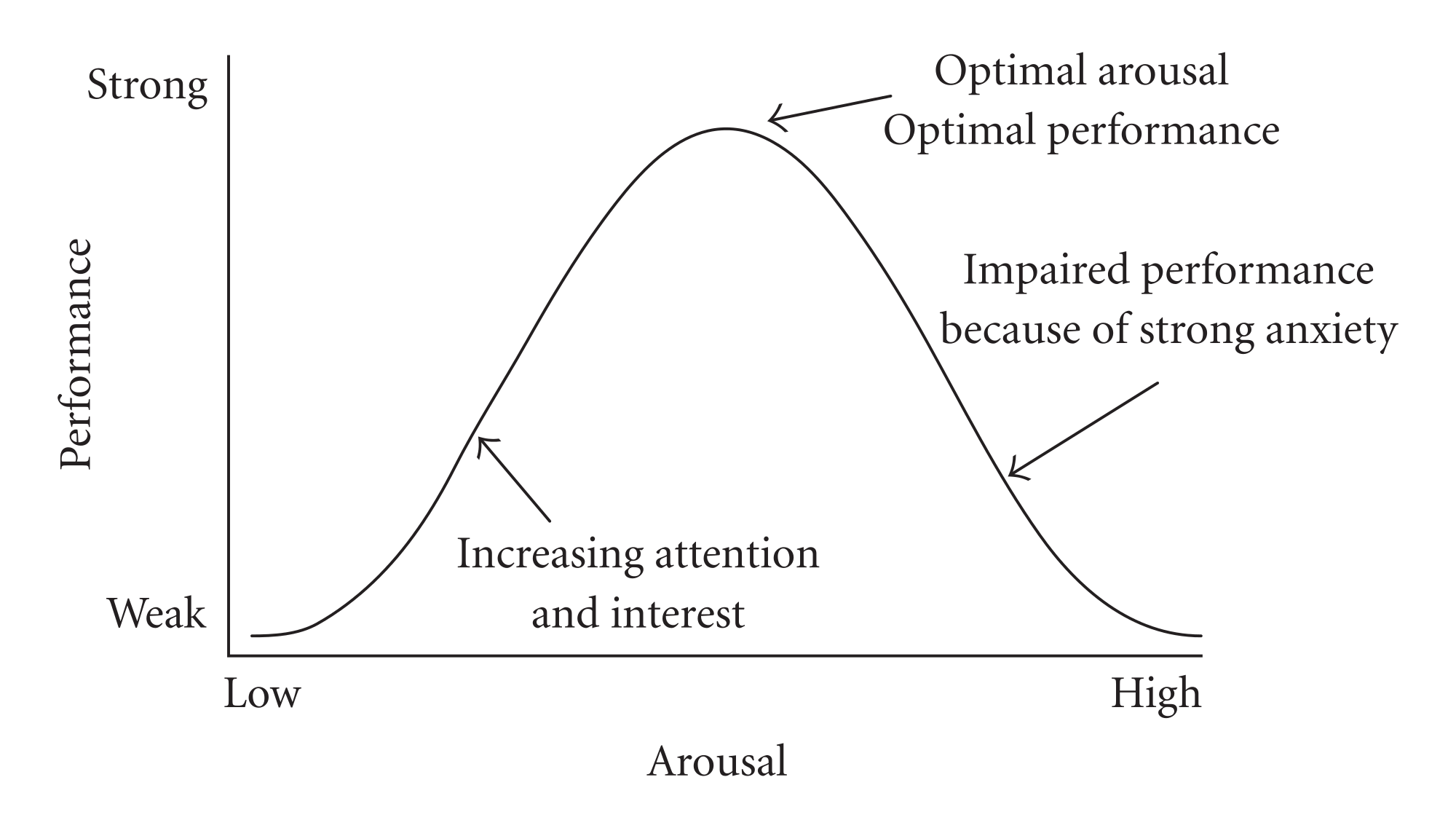
Early in psychology, we were exploring how to bring people out of their comfort zones and how our behaviour and habits are formed. In 1908 (The Yerkes-Dodson Law) psychologists studied anxiety levels and performance, and found that a small amount of anxiety is actually a positive thing for your performance. It has been further proven within studies ever since.

Anxiety primes our body for action, and sometimes that actually what we need to have the energy and the sense of being alert enough to push ourselves outside of our comfort zones, to push ourselves to learn something new, create a new routine or challenge ourselves. Called “optimal anxiety”, there is a place where our performance is aroused due to a low level of anxiety and stress caused by the unknown and unfamiliar.

There are more studies that suggest we actually perform higher if we are slightly stressed, and in my opinion it is because we are having to consciously think and learn new skills in order to adapt to our environments. If we are slightly pushed to learn new things (but have a structure in place in order to perform the routine activities) every day then we are in a state of constant learning and development. It helps us be more adaptable as human beings overall but also increases our happiness as we witness our own growth.

Small amounts of threat keeps up engaged and performing optimally

Believe it or not, the anxiety we are almost always trying to avoid can actually be helpful (in small, appropriate doses). If there is no loss that we can conceive, if there is no threat to run away from, then how can we be motivated to ever make a change or escape our comfort zones and challenge ourselves?

Keeping some chaos in your life is absolutely critical to your growth. You must give yourself a structure to work with. This “chaos” could simply be one small change to break up your routine that could completely change the way you live your life. A new job role, starting at the local gym or picking up a new hobby could be all you need to be in a state of optimal anxiety, which leads to higher performance.

Don’t forget to keep to remember to maintain the structure of your life and ensure that your lifestyle is stable and healthy. I should not have to mention that too much chaos can bring with it large amounts of anxiety, which can manifest themselves into many disorders such as panic disorder, generalised anxiety disorder, PTSD and many other personality disorders.

Create a balance. One foot in the structure, one foot in chaos. A healthy and stable lifestyle with the ability to adapt, journey through new experience, learn new skills and continue to grow as an individual. You should try to push yourself to new limits, challenge yourself to take on new opportunities and make positive, impactful changes in your life. If you want to speak to me about how I could help you as an hypnotherapist and personal coach, call me on 07825599340.

8 years ago · · 0 comments

Self Awareness & Self-Development: Two of The Same?

Self-awareness and self-development are both parts of the same package. As we learn more about ourselves, we are slowly tearing back layers of mental barriers that we’ve attributed to our experience we call life.

Our limitations are our own making. Looking at those who we believe to be successful in society, they are extremely self-aware. They have developed a true (authentic or congruent) image of themselves: their strengths, weaknesses, areas of improvement and most of all who they can become (their true potential).

They go on to escape their comfort zone, take full advantage of opportunities. Consequently, their confidence grows over time, each small success furthering their ambition, drive, and aim but also affirming to their belief that it is possible to achieve their goals.

It could be that experiences also allow us to break down these mental blocks and barriers, further strengthening our ability to shake our belief system and re-build ourselves into the new image we have developed.

Could your self-awareness aid self-development?

You can fool yourself into thinking that you undoubtedly know yourself, but it would be naive to believe that you have a true understanding of what you want in life, not to mention the intent and cause of all your behaviour and actions.

Identifying what you want to achieve and how you’re going to get there is what I would describe as self-awareness. You are aware of your limitations, though you are not bound by them. You know that you have potential to grow. As we develop our awareness of our own wants, wishes, desires, we discover what it would take to make us feel fulfilled within our lives.

How can you further your understanding of yourself? Your own personality, your traits and who you are?

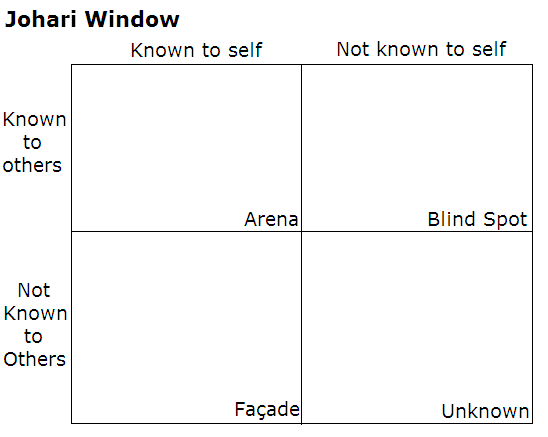
Johari’s Window remains an excellent tool for self-awareness and self-development, taught widely in Western culture within psychology and management and leadership.

An exercise in self-development, the participants describe their own traits from those within a set of adjectives. Those around them (his most familiar peers or those within the group setting) would subsequently describe them, using the same set of adjectives.

The words used by both parties (both the individual and those around him) would be placed upon the “Arena”, those that the participant described themselves as that others did not use would be placed within the area “Façade”, the peer’s observations that the participant did not recognise would be in the adjacent area “Blind Spot” and then there is the “Unknown” which represent the characteristics, talents or abilities that nobody may be aware of.

How do you think self-awareness affects your progression in your career, your relationships with others and your personal life? By being open to new experiences and embracing opportunities, it is possible to discover parts of yourself you never knew existed.

Could we work together to enable you to achieve your dreams? Contact me on to speak about how I could encourage you to change for the better.

8 years ago · · 0 comments

Escaping Nihilism: What To Do When Nothing Matters

Do you often feel like life is meaningless? Existential Nihilism is the viewpoint that deems the world as having no meaning or purpose. From this perspective, all existence is senseless, free will is denied and all thought and feelings are believed to be the effects of prior causes.#

It can be easy to get swooped into nihilism. As we lose faith in something, it indicates to our inner-selves that things can indeed fall apart. All those little failures from peers and the realisation that life is associated with suffering, that can quite easily tear our psyche apart.

Here’s a scenario to consider:
Imagine being a married, religious couple who are straight-forward Christians – only to find out your partner has been partaking in an affair for the last four years and you were none the wiser.

Just one experience in your life that you have failed to think through logically (and expressed your emotions appropriately) can build in resentment, bitterness and anger at not only your ex-partner but all members of the opposite sex and perhaps society itself. If you fail to deal with these new ideas, over time they become your perspective on life, your ideology.

You may not only lose faith in your partner, but yourself, your own ability to judge situations clearly, the religious ideology that marriage is sacred that you’ve forever upheld, perhaps even society itself for promoting promiscuity. There is a wide range of conclusions that someone might draw just from that one act alone, developing a completely new ideology based on their betrayal and contempt.

There is a logical conclusion (at least based on a negative and destructive ideology) that “life is suffering” and “everything is corrupt.”

In my humble opinion, living in the 21st Century (particularly in Western civilization) there is no call for us to be screaming corruption. There are many reasons we could point to that allude to the fact we are living in the most prosperous age of humanity.

Taking the viewpoint that life without objective meaning or purpose can have negative consequences as it provides you with an excuse to neglect the long-term, your personal responsibility (not only to society but to yourself). Although it does have its benefits (the alleviation of all responsibility), such an attitude can manifest into depression, anxiety and social withdrawal

We could delve deeper into history and philosophy to find the brilliant inventions and discoveries of the past thousand years that have allowed us to develop the technology that keeps our communities thriving every day, not to mention thousands of years of cultural development that has come alongside it and although corruption still exists, there is no denying that today’s society is the fairest and honest we have ever lived in.

There are some ways you can take back personal responsibility, let go of the ideology that life is meaningless and develop a real understanding of a life you feel is worth living

Analyse Your Ideology

Looking at the corruption throughout the world is so easy in this ever-connected age, where our access to information is such that we can Google news about anywhere in the world, anytime.

This gives us free access to information that affirms our ideology. The truth is out there for anyone to see just how much corruption does exist throughout the world.

Similarly, there are many positive things happening throughout the world that could choose to occupy our minds with.

Within the last decade, there have been more lifted out of poverty than ever before. There are many positive, life-affirming events that happen every day. People save lives and conflicts are resolved, ultimately it is up to you where you choose to focus your attention.

Start Where You Can
  • How are you with your loved one?
  • What about your family?
  • How clean and tidy is your own home?

All the above questions matter.

Nihilism could be your own interpretation of life due to some unfortunate circumstances that you’ve had to go through. It could be an experience (or several experiences) in your life that has somehow manifested into this belief that “nothing I do matters.”

This can in-turn allow you to neglect responsibility for your own life, which can be extremely detrimental to your long-term mental health and social well-being.

Start where you can. Fix your own life before jumping to conclusions about how you can fix the complex issues within society.

Give Yourself Meaning

We can attribute any meaning we want to live and work towards any goal we dream of. Imagine in your mind, an image of yourself in ten years that you dream of becoming. What does it look like?

How can you work towards it? What were the most important things about yourself within that image? What responsibilities did you have within that vision? How can you become the person capable of living up to your dreams?

Give your own life meaning. It will drive you forward and allow you to gather a long-term perspective.

Gather Long-Term Perspective

You can do more in a day than you can do in five minutes. You can do more in a decade than you can do in a year.

Thinking long-term and giving yourself time to achieve your goals will free up thoughts of meaningless and emptiness, which is how we might feel if we have nihilistic thoughts and belief systems.

Think through your daily thoughts. What do they attribute to your attitude, and how does that affect your daily life? Do you want help changing your attitude and behaviours? Give me a call on 07825599340 for a free confidential chat.