Schedule a Visit

Whatever you're looking for, I can help. Schedule a one-to-one with the form to the left, or you can contact me directly:

By phone:
07825 599 340

By email:

stuart@stuartdowning.com


8 years ago · · 0 comments

Ten Simple Ways To Increase Your Confidence

Confidence brings with it the chance to effectively connect with people, the courage to take on new challenges and most of all the strength to be ourselves.

The ways we can improve our confidence are countless. From new experiences, the delight of working alongside others, learning a new skill to quite simply putting faith in ourselves.

How would becoming more confident help you? Recognising and aiming towards your potential is what allows us to grow and mature as human beings, and we need the confidence to take on the opportunities that allow us to do that.

Working with clients across the globe, I’ve helped many people overcome fears, make hard changes and maintain more active lifestyles. A lack of confidence in themselves is what holds most people back. Why don’t you use some simple steps to become more confident in yourself over the course of then next twelve months?

Decide who you want to become

Increasing your self-awareness and defining what it is you want to achieve is a great way to start to increase your confidence.

Why do you want to increase your confidence? Why aren’t you already confident? What will increasing your confidence allow you to do?

The last question is of particular importance. Giving yourself reason to increase your confidence and attaching your level of confidence to your ability to take on new opportunities and grow your competence to achieve your goals in life.

Unleash your potential

Speaking of goals, what about your potential? The vast amount of hours we spend speaking about potential, which in reality is an imaginative force, the perception we have placed upon ourselves that has ultimately been deemed “the ideal.”

Taking on each day as an opportunity to unleash the potential you have is a good way to start increasing your confidence as it often brings you out of your comfort zone and places you in situations where you need to learn, adapt and grow.

Once you come to realise that you have a huge amount of potential and a unique perspective to offer the world, you tend to work harder to do what you can to ensure that you offer the most of your potential to those around you.

Who have you got the potential to become?

Educate yourself

If you want to become confident in any area, you need to educate yourself sufficiently in that area. To truly have the confidence to speak about a subject, you must first seek to educate yourself and understand it thoroughly yourself.

Read books, listen to audio, watch lectures on YouTube, search the website for useful articles and educational material. There is no reason to believe your ignorance is not wilful, particularly in today’s information age where you have every piece of data available at your fingertips.

Be humble (learn from others)

Another person’s perspective can be of incredible value, and it’s not something you can dismiss lightly. No matter who you are, you can learn from others who have either; more experience, wisdom, knowledge, skills or just another perspective on the situation.

If you want to stay confident in the long-term, don’t become arrogant. Ensure that you listen to others intently, with the attitude and belief that they may actually know something you don’t, and you could learn something from them (and the truth is, you probably can).

Speaking from a personal perspective as a therapist, I learn a tremendous amount from the experiences I share with my clients.

Face your fears

There is no better way to overcome insecurity than to face up to your fears. Is there much more I need to say?

You may have been to therapy, you may have heard this before. Facing up to the thing you fear the most and taking the challenge head-on will be one of the most enlightening moments of your life in regards to your confidence levels.

Be truthful

Base your own life on a foundation of truth. There are two primary elements to this piece of advice.

Be truthful to yourself: don’t deceive yourself. Knowingly or unknowingly we all lie to ourselves, and the less we do of that, the better our frames of minds will be. Don’t distort reality, don’t cover up your inadequacies.

Be truthful with others: working on a foundation of truth and respect, you protect yourself from becoming over-committed to the needs of others or becoming too selfish in your own greed and deceit (which can happen to us all..)

How often do you deceive yourself and those around you? Lying and deception fundamentally distorts the psyche and contributes to stress, anxiety, depression and mental health deterioration.

Set yourself free. Tell the truth.

Develop your courage to say no

Do you often find yourself in situations you’d rather have not been in? Are you struggling to say no to others? Do you take on opportunities at will because they’re handed to you? By accepting every opportunity or giving into every demand of other people, you can build up resentment and anger with the fact that you just cannot say no!

I’ve met many people like this within my work. They’re just far too agreeable.

The fact Is that in life, we are faced with making a decision in the pool of unlimited possibilities. We couldn’t possibly take on every opportunity, nor can we please everyone around us. Sometimes we have to do what is best for ourselves, and without the ability and courage to decline the offer to either party with friends, take on a new job opportunity or relocate with your partner, all against your own best wishes and all because you didn’t tell them how you truly felt.

You would be surprised at how fast your life can spin out of control (and into the control of those around you) if you build up the strength to learn to say no.

Over-agreeable people have a tendency to become anxious and resentful at the fact they cannot stand up for themselves. Don’t let that be you, develop the ability to stand up for yourself.

Be open to new experience

There is nothing in this world that allows you to grow your confidence more than being open to new experiences.

True both in your professional and personal life, you must be open to trying out new things to explore the many conceptions of being within yourself. What are you good at? What do you enjoy? Without exploring new experiences, how would you ever know?

It could be as simple as taking on a new project, or exploring a new hobby. Try something new. Don’t be afraid to step outside of your comfort zone. It will allow you to grow and develop your character and you never know, you might find out more about than you realise.

Be decisive and have a definiteness of purpose

How long does it take you to come a firm decision?

Even more importantly, do you stick to your decisions and allow the results to come to fruition before moving on to something new?

Make sure your long-term aims are well conceived. Create the vision you want to work towards. Take the perspective that each decision you make (however small) leads to (or away) from your purpose.

Don’t be impulsive with your decision making, ensure that each decision you make is a step towards your long-term goals. Ultimately this is what will allow you to move forward with a definiteness of purpose.

Recognise your individual worth

Recognising your own self-worth is a hard one. As human beings we all have an intrinsic value that can never be taken away from us. Only through lack of confidence in ourselves would we have a deflated and distorted value of ourselves.

What are you worth? This applies to both your experience, your knowledge and your perspective within the workplace, but also to your time and energy within your personal relationships.

I bet it’s a hell of a lot more than you think.

You can transform the way you think about yourself. You can develop a new image for your existence. You can bring into fruition your vision for the future.

And when you do? Your personal and professional relationships improve. You grow. You build a life that is based upon truth and you contribute the overall well being of your community and society at large. Confidence breeds confidence. What could you do to improve upon your confidence and get a good streak of fortune come your way over the coming months? Get in touch to speak about the personal and professional coaching I offer, you can call me on
8 years ago · · 0 comments

Escaping Your Comfort Zone: Taking Advantage of Chaos

How often do you do something different? When were you last challenged? What was the last new thing you learned that helped you grow as a person?

We all need the “optimal challenge”, something just outside of out comfort zone that pushes us to become more. There’s lots of studies that suggest escaping your comfort zone is extremely good for you (when you can do it), but also why it’s extremely hard.

Your habits and routine literally become hardwired into you. And they can become very hard to change.

Put simply, our comfort zone is a behavioural space where our activities and behaviours become part of our routines. This helps to lower risk and stress, giving us a natural state of mind in which we can function and perform our routines habits on a daily basis. We all need this and it can not be seen as neither bad nor good, but if we are never stretched out of our comfort zones then how can we ever change our behaviour, attitude and reality?

The problem is that when we do try to leave our comfort zones, we face uncertainty, which manifests as anxiety and worry. Anyone who has ever done anything new or pushed themselves to live up to the challenge knows that it can be hard work, embarrassing and exhilarating all at the same time (for example, if you are doing your first public speech, performing within sports teams or starting a new challenging job role) as you perform at new heights and take on new opportunities that leave you with moments of vulnerability.

Structuring your chaos

So how can we find a balance? How do we escape our comfort zones and learn something new whilst also maintaining structure and order? As we age and become more settled in our ways, we have formed our belief systems and simultaneously learned our place within the world as we slowly begin to accept and reinforce our identity within the structure of society (our status).

We begin to become ordered, and less chaotic. This becomes the comfort zone. We develop our frameworks to live within, daily habits that allow us to function. What do we to happen to allow us to escape our comfort zones and learn something new? We may indeed that little bit of chaos to take us from our order and routine.

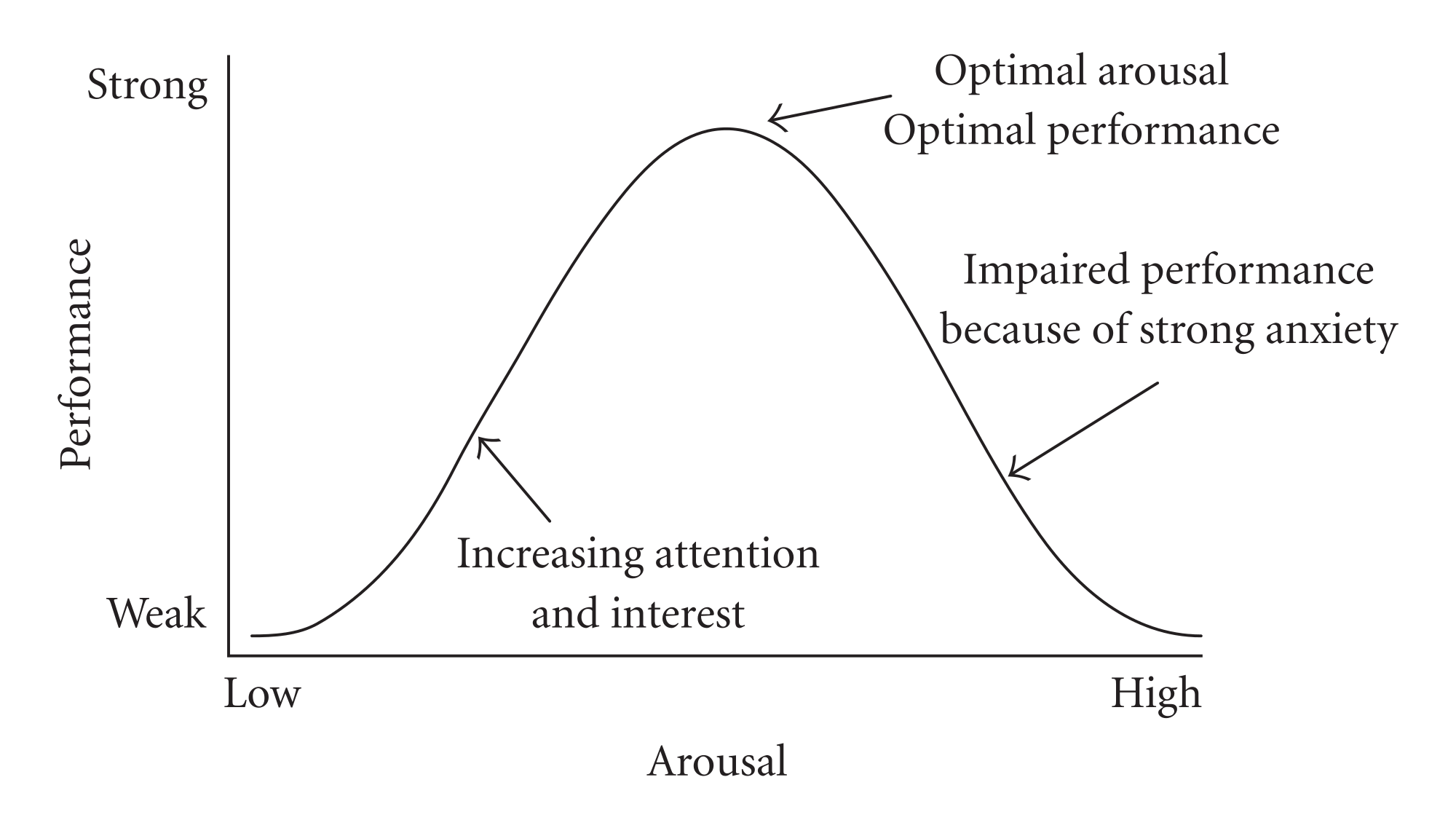
Early in psychology, we were exploring how to bring people out of their comfort zones and how our behaviour and habits are formed. In 1908 (The Yerkes-Dodson Law) psychologists studied anxiety levels and performance, and found that a small amount of anxiety is actually a positive thing for your performance. It has been further proven within studies ever since.

Anxiety primes our body for action, and sometimes that actually what we need to have the energy and the sense of being alert enough to push ourselves outside of our comfort zones, to push ourselves to learn something new, create a new routine or challenge ourselves. Called “optimal anxiety”, there is a place where our performance is aroused due to a low level of anxiety and stress caused by the unknown and unfamiliar.

There are more studies that suggest we actually perform higher if we are slightly stressed, and in my opinion it is because we are having to consciously think and learn new skills in order to adapt to our environments. If we are slightly pushed to learn new things (but have a structure in place in order to perform the routine activities) every day then we are in a state of constant learning and development. It helps us be more adaptable as human beings overall but also increases our happiness as we witness our own growth.

Small amounts of threat keeps up engaged and performing optimally

Believe it or not, the anxiety we are almost always trying to avoid can actually be helpful (in small, appropriate doses). If there is no loss that we can conceive, if there is no threat to run away from, then how can we be motivated to ever make a change or escape our comfort zones and challenge ourselves?

Keeping some chaos in your life is absolutely critical to your growth. You must give yourself a structure to work with. This “chaos” could simply be one small change to break up your routine that could completely change the way you live your life. A new job role, starting at the local gym or picking up a new hobby could be all you need to be in a state of optimal anxiety, which leads to higher performance.

Don’t forget to keep to remember to maintain the structure of your life and ensure that your lifestyle is stable and healthy. I should not have to mention that too much chaos can bring with it large amounts of anxiety, which can manifest themselves into many disorders such as panic disorder, generalised anxiety disorder, PTSD and many other personality disorders.

Create a balance. One foot in the structure, one foot in chaos. A healthy and stable lifestyle with the ability to adapt, journey through new experience, learn new skills and continue to grow as an individual. You should try to push yourself to new limits, challenge yourself to take on new opportunities and make positive, impactful changes in your life. If you want to speak to me about how I could help you as an hypnotherapist and personal coach, call me on 07825599340.

8 years ago · · 0 comments

Self Awareness & Self-Development: Two of The Same?

Self-awareness and self-development are both parts of the same package. As we learn more about ourselves, we are slowly tearing back layers of mental barriers that we’ve attributed to our experience we call life.

Our limitations are our own making. Looking at those who we believe to be successful in society, they are extremely self-aware. They have developed a true (authentic or congruent) image of themselves: their strengths, weaknesses, areas of improvement and most of all who they can become (their true potential).

They go on to escape their comfort zone, take full advantage of opportunities. Consequently, their confidence grows over time, each small success furthering their ambition, drive, and aim but also affirming to their belief that it is possible to achieve their goals.

It could be that experiences also allow us to break down these mental blocks and barriers, further strengthening our ability to shake our belief system and re-build ourselves into the new image we have developed.

Could your self-awareness aid self-development?

You can fool yourself into thinking that you undoubtedly know yourself, but it would be naive to believe that you have a true understanding of what you want in life, not to mention the intent and cause of all your behaviour and actions.

Identifying what you want to achieve and how you’re going to get there is what I would describe as self-awareness. You are aware of your limitations, though you are not bound by them. You know that you have potential to grow. As we develop our awareness of our own wants, wishes, desires, we discover what it would take to make us feel fulfilled within our lives.

How can you further your understanding of yourself? Your own personality, your traits and who you are?

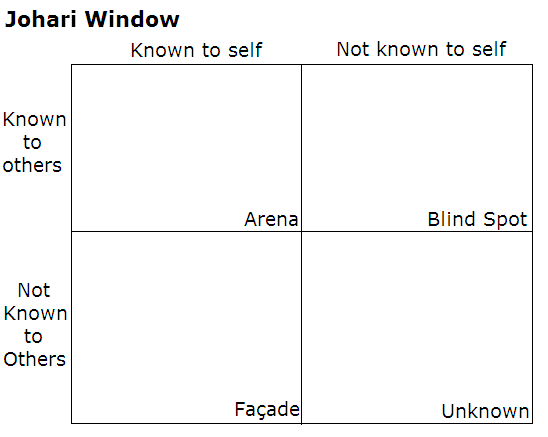
Johari’s Window remains an excellent tool for self-awareness and self-development, taught widely in Western culture within psychology and management and leadership.

An exercise in self-development, the participants describe their own traits from those within a set of adjectives. Those around them (his most familiar peers or those within the group setting) would subsequently describe them, using the same set of adjectives.

The words used by both parties (both the individual and those around him) would be placed upon the “Arena”, those that the participant described themselves as that others did not use would be placed within the area “Façade”, the peer’s observations that the participant did not recognise would be in the adjacent area “Blind Spot” and then there is the “Unknown” which represent the characteristics, talents or abilities that nobody may be aware of.

How do you think self-awareness affects your progression in your career, your relationships with others and your personal life? By being open to new experiences and embracing opportunities, it is possible to discover parts of yourself you never knew existed.

Could we work together to enable you to achieve your dreams? Contact me on to speak about how I could encourage you to change for the better.

8 years ago · · 0 comments

Escaping Nihilism: What To Do When Nothing Matters

Do you often feel like life is meaningless? Existential Nihilism is the viewpoint that deems the world as having no meaning or purpose. From this perspective, all existence is senseless, free will is denied and all thought and feelings are believed to be the effects of prior causes.#

It can be easy to get swooped into nihilism. As we lose faith in something, it indicates to our inner-selves that things can indeed fall apart. All those little failures from peers and the realisation that life is associated with suffering, that can quite easily tear our psyche apart.

Here’s a scenario to consider:
Imagine being a married, religious couple who are straight-forward Christians – only to find out your partner has been partaking in an affair for the last four years and you were none the wiser.

Just one experience in your life that you have failed to think through logically (and expressed your emotions appropriately) can build in resentment, bitterness and anger at not only your ex-partner but all members of the opposite sex and perhaps society itself. If you fail to deal with these new ideas, over time they become your perspective on life, your ideology.

You may not only lose faith in your partner, but yourself, your own ability to judge situations clearly, the religious ideology that marriage is sacred that you’ve forever upheld, perhaps even society itself for promoting promiscuity. There is a wide range of conclusions that someone might draw just from that one act alone, developing a completely new ideology based on their betrayal and contempt.

There is a logical conclusion (at least based on a negative and destructive ideology) that “life is suffering” and “everything is corrupt.”

In my humble opinion, living in the 21st Century (particularly in Western civilization) there is no call for us to be screaming corruption. There are many reasons we could point to that allude to the fact we are living in the most prosperous age of humanity.

Taking the viewpoint that life without objective meaning or purpose can have negative consequences as it provides you with an excuse to neglect the long-term, your personal responsibility (not only to society but to yourself). Although it does have its benefits (the alleviation of all responsibility), such an attitude can manifest into depression, anxiety and social withdrawal

We could delve deeper into history and philosophy to find the brilliant inventions and discoveries of the past thousand years that have allowed us to develop the technology that keeps our communities thriving every day, not to mention thousands of years of cultural development that has come alongside it and although corruption still exists, there is no denying that today’s society is the fairest and honest we have ever lived in.

There are some ways you can take back personal responsibility, let go of the ideology that life is meaningless and develop a real understanding of a life you feel is worth living

Analyse Your Ideology

Looking at the corruption throughout the world is so easy in this ever-connected age, where our access to information is such that we can Google news about anywhere in the world, anytime.

This gives us free access to information that affirms our ideology. The truth is out there for anyone to see just how much corruption does exist throughout the world.

Similarly, there are many positive things happening throughout the world that could choose to occupy our minds with.

Within the last decade, there have been more lifted out of poverty than ever before. There are many positive, life-affirming events that happen every day. People save lives and conflicts are resolved, ultimately it is up to you where you choose to focus your attention.

Start Where You Can
  • How are you with your loved one?
  • What about your family?
  • How clean and tidy is your own home?

All the above questions matter.

Nihilism could be your own interpretation of life due to some unfortunate circumstances that you’ve had to go through. It could be an experience (or several experiences) in your life that has somehow manifested into this belief that “nothing I do matters.”

This can in-turn allow you to neglect responsibility for your own life, which can be extremely detrimental to your long-term mental health and social well-being.

Start where you can. Fix your own life before jumping to conclusions about how you can fix the complex issues within society.

Give Yourself Meaning

We can attribute any meaning we want to live and work towards any goal we dream of. Imagine in your mind, an image of yourself in ten years that you dream of becoming. What does it look like?

How can you work towards it? What were the most important things about yourself within that image? What responsibilities did you have within that vision? How can you become the person capable of living up to your dreams?

Give your own life meaning. It will drive you forward and allow you to gather a long-term perspective.

Gather Long-Term Perspective

You can do more in a day than you can do in five minutes. You can do more in a decade than you can do in a year.

Thinking long-term and giving yourself time to achieve your goals will free up thoughts of meaningless and emptiness, which is how we might feel if we have nihilistic thoughts and belief systems.

Think through your daily thoughts. What do they attribute to your attitude, and how does that affect your daily life? Do you want help changing your attitude and behaviours? Give me a call on 07825599340 for a free confidential chat.

Counselling or Hypnotherapy: What Works?

8 years ago · · 0 comments

Counselling or Hypnotherapy: What Works?

Counselling and hypnotherapy can both have a useful impact in your life, and in major ways. But what is the difference and how can each help you tackle what are seemingly the same issues (anxiety, depression, confidence and other mental health issues).

As we progress through life, we can often become lost. It’s not uncommon to need support at least some point in your life. If you are looking to make a change and are considering the options available to you, it’s true that counselling can be highly beneficial in self-awareness and understanding who it is you wish to become. Hypnotherapy is much more direct and can be better at changing specific habits and behaviours that may be destructive.


Counselling (first deemed “talking therapy” and now what we refer to say “psychotherapy”) as first developed in part by Freud,  Yung and Rogers focus on three primary disciplines:

Psychodynamic – Freud developed his talking therapy, which was aimed at allowing a place for the patient (and he called them patients) to use free association and speak freely within a confidential environment. A lot of his work was focused on the subconscious, which was something that Freud proposed and discovered himself and predicated on the fact our behaviour was a manifestation of repressed feelings and thoughts from the past.

Cognitive Behavioural Therapy (CBT) – Inspired by the work of Carl Yung, this approach suggests behaviours are habitual and learned. We can “unlearn” habits that can be replaced by new ones by talking control of our thought patterns, emotions and therefore behaviour (and subsequent consequences).

Humanistic (person-centred) – Carl Rogers was highly influenced by the hierarchy of needs and the work of Abraham Maslow. The relationship between the client and the counsellor is focused on active listening, using three positive components that allow the client’s growth:

  • Unconditional Positive Regard
  • Empathy
  • Congruence.

Counselling is a place in which the client is given chance to speak confidentially about their problems, and take one of the three approaches to understanding their thoughts and actions. The purpose of counselling is to provide clarity and understanding to client and further their self-awareness, allowing them to understand why it is they feel or act in a certain way.

Could Hypnotherapy be a better alternative?

Hypnotherapy is the act of inducing a hypnotic state in clients to increase motivation and alter behaviour patterns. This work includes preparing clients to enter a hypnotic state by explaining how hypnosis works, inducing them into a hypnotic state and using autosuggestion to replace habits in the client.

Hypnotherapy has been around for hundreds of years, though within the 21st Century it was further developed by Milton H. Erickson (“Ericksonian Hypnotherapy”) and solution-focused hypnotherapy particularly have had a huge impact on how we can hypnosis to solve client’s problems.

Predicated much more on altering the behaviour patterns of hypnotherapy, it is better for those who are willing to make serious changes in their lives, rather than counselling which may help understand your thoughts and feelings more coherently.

Are you looking to make a change? My services include psychotherapy and hypnotherapy, helping clients from a range of issues from chronic pain and irritable bowel syndrome to drug addictions, anxiety, depression and a wide range of mental health issues. Get in touch today to make the change you want to see in your life.

How NLP Can Help In Your Career

8 years ago · · 0 comments

How NLP Can Help In Your Career

NLP teaches that our mind-body (neuro), what we say (language) interact to form our perception of the world (programming), which then determine our feelings and behaviours.

The therapy focuses on discovering how we currently perceive the world (or what NLP would deem our “internal map”) and looking to re-create these patterns into more productive and efficient models, working on the pretence that anyone can learn the skills needed to be successful.

That means that we can study the people who have achieved success in their lives – and anyone can learn those same skills and apply them to their lives.

According to NLP, our internal maps are the things that predicate how we perceive the world and how we interact with the world. The assumption is that we only have certain resources within our perception, we can only perceive the world from one angle and hold one set of beliefs.

How can it help you in your career?

What is it that makes the successful become so successful? Practitioners of NLP look at the behavioural habits of those who achieve great success in life and look to instil that into patients, or themselves using affirmative thoughts and behaviours and replacing the thoughts patterns and hence altering their entire perception of the world.

As we navigate through our lives, we pick up belief systems and thought patterns that are instilled to us from society. Our families, the educational system, religion, your culture. Thousands of years in the making, all of which have had effects on your beliefs systems and the way you perceive yourself than you ever know.

Look at the successful people in your industry. Look at those who are successful in the company you work at. What are they doing differently to others? More importantly, how do they perceive the world? Are they limiting themselves in their thoughts and what they say, or do they seem to be positive and open to opportunity? By understanding how those who are successful have become so, we can use those same attributes within ourselves and learn the skills needed in order to replicate their behaviour.

NLP can help you in your career if you take the following three steps:

  • Understand how you perceive the world determines how the world will present itself to you and therefore how you react to opportunity
  • Choose a “model” whose life and behaviour resembles what you would deem the ideal
  • Work to conceptualise the world as your chosen model would think; working towards having the same attitude, belief, thought patterns and behavioural habits.

The way you perceive the world will determine how you react with the world. The truth exists that we are not capable of perceiving everything, nor are we capable of holding two sets of beliefs are the same time. We must choose not only how we perceive the world but what we perceive in the world. Will it be one full of scarcity and fear or one full of opportunity and freedom?

Can I help you replace your internal map with my NLP Coaching? Get in touch today on 07825599340.

Personal Development: The Importance of Setting Goals

8 years ago · · 0 comments

Personal Development: The Importance of Setting Goals

A personal development plan offers a great way to ensure that each job role and experience feels more meaningful, offers you a purpose and gives you an amazing insight into the future and is excellent for developing an efficient long-term perspective within your career.


Firstly, the definition of a personal development planning is “the process of creating an action plan based on awareness, values, reflection, goal-setting, and planning for personal development within the context of a career, education, relationship or for self-improvement.” In the terms we’re looking at within this article will be focused on improving your career and employability, but there are of course many other ways a personal development plan can be crucial.

A lot of people have a clear plan in their head where they’d like to be, though putting that into a plan that is actionable, has targets and drives you towards a goal? That can be enlightening.

Suddenly you may find that, rather than a fussy idea and the wish to be something you have yet to start working towards (having no clear aims, goal, nor plan), your life becomes so much more fulfilled when you’re working towards a structured plan on how it is you will achieve your dreams (it may sound a little exaggerated, but that’s what I believe it can truly provide if you’re self-aware enough to know what it is you want with certainty).

Another strong advantage of having a personal development plan is that motivational levels have been repeatedly seen to increase upon the creation and implementation of a plan. Although the percentage varies, every study ever produced in regards to setting goals and achieving targets has found a clear correlation between those who set specific goals that are actionable, and those who achieve.

There are many benefits of setting goals within your professional and personal life. Some of these being:

  • More organised thoughts
  • Allows for more introspection and self-reflection
  • More positive feeling about your current employment or situation
  • Help identify current and future needs, which allows you to see the long-term perspective


Furthermore, if used in the context of your own life and career, the results can be riveting. Here are some tips on creating your own personal development plan:

Set SMART goals

Setting SMART goals will help in any business decision, but it is the same in your personal development. SMART goals are certainly something that are used in business; though they can also be used to drive personal growth. They’re widely popular and have shown to have positive results for those who employ the tactic, evidenced by the way it is used within organisations and taught throughout schools worldwide. They encompass everything we need to ensure that we do not fail within our goal-setting, and for those who need an explanation:

SPECIFIC – be specific in the goal which you set. For example, don’t say “I want more money” say “I want to earn £2500 per month.”

MEASURABLE – ensure that the goal is measurable. For example, don’t say “increase sales” but “increase sales by 50%” – it helps.

ACHIEVABLE – ensure the goal is achievable. This is really about setting yourself an achievable, realistic goal.

RELEVANT– is the goal relevant to the objective? Aims become the individual’s purpose, the objective is the way in which you will do so and the goal is what is to be achieved.

TIME – set a time limit. How hard can it be? Setting a time limit gives us something to work towards in a definite amount of time, providing urgency.


Increase your level of self-awareness

Self-awareness is crucial to any personal development planning. Without it you are sure to fail, your plan consistently changing and adapting to the new ideas you come up with. You need to be definite in your approach to planning your future, and self-awareness allows you to know what you truly want, and find a way to work towards it.

Take real action

I feel this is the most crucial point of the whole topic. Upon setting a plan you should make sure they have actionable steps that you can take in order to achieve your goal – then do it. You could have a million plans, each of them as huge as the next, but without action they’ll never manifest into reality.

Carl Rogers said that in order to achieve a true feeling of congruence within our lives, our ideal-self much closely match the reality of our actions and behaviours. How can you act differently today to further enhance your journey to fulfilment, achievement and purpose? One change is all it could take.

Does Hypnotherapy Work (Scientifically)

8 years ago · · 0 comments

Does Hypnotherapy Work (Scientifically)

When you’re looking online for information about hypnosis and hypnotherapy, you will find an abundance of information.

You’ll find article upon article, study after study, practitioner after practitioner. The problem? You don’t know what’s right and what’s wrong, and how could you?

The real issue comes from the fact that anyone, whether accredited or not can set up as a “hypnotherapist” and offer services without any training or certificate. This leaves real qualified, certified professionals on the back-foot, as the work and training required to get to a level you can successfully work with clients takes time, study and practice. What sets aside those pushing bad advise and those pushing good advise? Particularly when you can brand yourself online, set up a website and be an “expert”.

What do the studies say? How can I find information?

The truth is that we don’t know the full extent of how powerful our minds are, and how hypnosis and hypnotherapy can really help improve our lives on many levels.

During the 20th had great thinkers from psychologists such as Freud whose psychodynamic research shed light on both the conscious and subconscious mind, the behavioural and humanistic perspectives giving us the “Self-Image” and of course hypnotherapists such as Erikson that gave us compelling studies, work and research on the use of hypnosis as a therapy.

The fact is, we’re at the cutting-edge of psychological therapy. That is, there are so many choices. Truer still is that fact that often it can be the individual and their willingness to change that is of real importance, not the way in which you tackle the situation.

There are many studies out there, and the news is mostly good. We’ve just recent studies and articles that showcase hypnotherapy alters areas of the brain during hypnotic trances. We’ve had some excellent discoveries about how hypnotherapy can work with anxiety, depression, IBS, chronic pain and many other aspects of an individual’s life. Let’s look at some areas that hypnotherapy has been proven scientifically to work on:

You can find information on Google Scholar in regards to studies and case studies, and there are some great studies cited at the UK College of Hypnosis and Hypnotherapy gives us some excellent insights into many separate issues that hypnotherapy can successfully deal with.


Anxiety/Phobia

Anxiety is one of the areas that hypnotherapy has some of the best results. Some of the changes I’ve seen in clients as we’ve gone through therapy has been nothing short of a miracle.

As we can actively deal with your thoughts, your mind and allow you to fully take control of your emotions, it seems that hypnotherapy is the best treatment for anxiety of them all (even the British Medical Association agrees).

“Following an extensive review of the existing literature on hypnotherapy, the British Medical Association concluded that hypnotherapy was not only effective but may be ‘the treatment of choice’ in dealing with anxiety (‘psychoneurosis’) and stress-related (‘psycho-somatic’) disorders: ‘The Subcommittee is satisfied after consideration of the available evidence that hypnotism is of value and may be the treatment of choice in some cases of so-called psycho-somatic disorder and psychoneurosis. It may also be of value for revealing unrecognised motives and conflicts in such conditions. As a treatment, in the opinion of the Subcommittee it has proved its ability to remove symptoms and to alter morbid habits of thought and behaviour. […]’ (BMA, ‘Medical use of hypnotism’, BMJ, 1955, vol. I, 190-193)”


Chronic Pain

The mind is a powerful resource.

You must remember that every sensation that you feel originates within your mind, whether emotional or physical.

Chronic pain is an area that I profusely enjoy working on, because I can see the relieve of patients when we’re finished with the therapy. During just a couple of hours, we can revolutionise how you feel in your everyday life.

Some excellent studies have proven the effectiveness of hypnotherapy on chronic pain.

“A recent ‘Clinical Review’ of hypnosis and relaxation therapies published in the BMJ looked at the existing research on hypnosis and concluded: ‘Randomised controlled trials support the use of various relaxation techniques for treating both acute and chronic pain,’ (Vickers & Zollman, ‘Hypnosis and relaxation therapies,’ BMJ 1999;319: 1346-1349)”


Irritable Bowel Syndrome

Research and studies has shown that hypnotherapy has been successful in the improvement in symptoms of those with irritable bowel syndrome. I can attest to this personally and you will see that some of my testimonials include work I’ve done for my own clients with IBS within my testimonials page.

An experimental study of 12 patients with IBS showed that treatment resulted in significant improvement in symptoms and reduction in related anxiety. (Galovski, T.E., and E.B. Blanchard, ‘The treatment of irritable bowel syndrome with hypnotherapy.’ Applied Psychophysiology & Feedback, 1998: Dec., vo. 23(4):219-232)]


Insomnia

Insomnia can be a tough one for anyone. Again one of my specialities, there has been some excellent research done on hypnotherapy for insomnia that has provided us an insight into the effectiveness of treatment with hypnosis and relaxation therapies.

The results are extremely positive.

“A recent ‘Clinical Review’ of hypnosis and relaxation therapies published in the BMJ looked at the existing research on hypnosis and concluded that hypnosis was proven to be effective for treating insomnia. (Vickers & Zollman, ‘Hypnosis and relaxation therapies,’ BMJ 1999;319: 1346-1349)”


Self-Hypnosis

It seems that self-hypnosis has been used to treat a wide variety of clinical problems. Successful outcomes involving self-hypnosis with adults or children have been reported for the following areas:

  • Anxiety
  • PTSD
  • Panic Disorders
  • Chronic Pain
  • Habit disorders (smoking, over-eating, alcoholism, drug addiction)
  • Insomnia
  • Depression
  • Self-Confidence

Have you tried to change many times, but to no prevail? Sometimes we can be stuck in a succession of many habits, all of which consume our daily lives. Over time, we’ve become adjusted to this way of life. One change can make all the difference.

Could You Help Yourself With Self-Hypnosis? Autosuggestion Explained

8 years ago · · 0 comments

Could You Help Yourself With Self-Hypnosis? Autosuggestion Explained

Could you help take control of your life with self-hypnosis and autosuggestion? Autosuggestion can be a real, practical way to change behaviour and influence your life in huge ways.

Since it’s conception, autosuggestion has been used as a form of self-hypnosis, self-development, psychotherapy and hypnotherapy. Developed in the early 20th, there are two separate forms of authosuggestion identified:

  • intentional, “reflective autosuggestion“: made by deliberate and conscious effort, and
  • unintentional, “spontaneous auto-suggestion“: which is a “natural phenomenon of our mental life … which takes place without conscious effort.”

The fundamental we can derive from the power of autosuggestion is that any idea exclusively occupying the mind turns into reality. Your dominant thoughts translate themselves into their physical reality as you progress through life. If used practically, we can ensure that the vision we hold and the future we bring to fruition is a life that we truly desire.

Here are four practical ways you can use autosuggestion to help shape your subconscious mind, change your habits and completely restructure your life.

Defining Your Ideal Self

Are you constantly saying to yourself that you have more potential? Do you hold an image in your mind of the happier, more reliant, more successful you? The person who has the life you dream about.

You need to define who it is you want to become. This will drive your action for change by impressing into your mind a fixed image of who you want to become, providing clarity and vision for your future goals.

Pay Attention To Your Mental Diet

What are you feeding yourself (mentally)? What are you telling yourself every day? This is what we call our self-talk.

Watch your self-talk. Think about the voices that are present in your mind. We all talk to ourselves, it doesn’t take a psychiatric patient to “talk to themselves.” The difference between those with a mental health problem and those without? It’s what they tell themselves!

Use A Positive Affirmation, Speak In Present Tense

Do you really want to believe yourself? Just use the present tense when you’re talking about your desires and ambitions.

Some examples:

“I don’t want to work for other people .” – “I will register my own business.”

“I am not making enough money.” – “I aim to make £2000 this month.”

Can you see how those are different? We have a strange tendency to attract what we think about into our lives. Make sure you’re thinking in positive affirmations, not in negative ones.

Hold Faith: It Doesn’t Happen Overnight!

Just with anything, using autosuggestion to ensure that you remain positive and are focused on your goals can take time. The brain is a muscle, the more we use it the stronger it becomes.

When you hold faith, have a true belief in your abilities and can say with certainty that you are working towards your dreams, when you can truly say that you’re staying focused and working to become the person you need to be? Only then will your dreams come true.

Understanding Your Destructive Habits: 12 Signs of Self-Sabotage

8 years ago · · 0 comments

Understanding Your Destructive Habits: 12 Signs of Self-Sabotage

Why is it that I consistently don’t live up to my potential?

Why don’t I put the time I have to good use like I often plan to?

Why do I continue unhealthy habits that I know are causing me permanent damage?

Who doesn’t think this from time to time? Self-destruction is a topic we a scared to talk about because it involves one thing we’re hard at… being truthful to ourselves.

If you’ve come to this article, you probably suspect deep down that in some way you are a self-destructive person.  If you are wanting better clarification or even confirmation that you are preoccupied with destructive behaviour and how you can change, then you’re in the right place.

Self-awareness is a huge advantage when it comes to identifying your own self-sabotaging behaviours, and understanding the ways you’re being self-destructive can be a great place to start.

Addictions

Drinking alcohol, taking drugs and other addictive behaviours? I’ve seen all too well how that can send your life into a spiral, not only harming you but those around you.

Addictions are one of the highest forms of self-destructive behaviour and over time destroys self-esteem and your confidence, becoming a deadly cycle that keeps you trapped in an unproductive lifestyle.

Emotional neglect

Are you handling your emotions, or are you actively blocking out your thoughts and feelings?

Repressed emotions are not good for your mental or emotional wellbeing. Failing to express emotion (both positive and negative) is a self-sabotaging behaviour and one that you need to fix if you wish to become free from anxiety and stress.

Nihilism

Feeling like nothing matters?

Nihilism is “the rejection of all religious and moral principles, in the belief that life is meaningless.”

Those who undertake this attitude tend to become lost, unaware of their real purpose and extremely unmotivated.

A purpose, meaning and a fulfilling role within society are the key aspects of our mental wellbeing; ultimately that is what keeps us sane. The feeling that nothing matters can manifest into self-sabotaging behaviours such as spending recklessly, not planning for the long-term and having little to no interest in your career and personal responsibility.

Disrupted Eating

Are you undereating? What about eating too much? This can be a sign of low self-esteem and issues with your self-image and confidence levels.

If you’re neglecting to feed yourself, this can have serious side-effects long-term and can be classified as self-harm.

Lacking Belief In Self

Are you constantly pulling yourself down? Do you have a low estimation of your own abilities?

This is one of the most subtle ways of self-sabotage because in the long-term you miss out opportunities to develop your skills and ultimately progress within your life.

Without standing up for a belief in your ability to do anything new, how will you ever progress?

Speaking Down About Yourself

Related to the above, but this is what you’re saying about yourself.

What do you say to others about who you are? How about what you say to yourself, about yourself?

This can be a huge indication of how you actually see yourself. Don’t allow the words that you say and how you speak about yourself trap you into a fixed state of mind.

Being Too Agreeable

Sometimes, you hide the fact you have given up by yourself by accommodating other people’s needs.

In fact, being agreeable makes you blissfully unaware of your sense of self, an excellent way of escapism that seems selfless.

Social suicide

Do you purposely (or perhaps, unconsciously) do things that alienate you from your social group? A tendency for anti-social behaviour or being deliberately arrogant, irritating and annoying can be some signs you’ve developed a self-destructive habit when it comes to forming mutual relationships and friendships.

Anxiety & Worry

Not all anxiety is bad. We need it to keep us alert in situations that may be dangerous for us, it’s the “fight or flight” aspect of us that keeps us aware of hazardous situations.

It’s when our anxiety and worry are not constituted with any real threat that becomes the problem.

According to a book by Earl Nightingale, a prolific researcher on personal development, only 8% of our worries are legitimate. Here’s an excerpt from his book, How to Completely Change Your Life in 30 Seconds:

  • Things that never happen: 40 percent. That is, 40 percent of the things you worry about will never occur anyway.
  • Things over and past that can’t be changed by all the worry in the world: 30 percent.
  • Needless worries about our health: 12 percent.
  • Petty, miscellaneous worries: 10 percent.
  • Real, legitimate worries: 8 percent. Only 8 percent of your worries are worth concerning yourself about. Ninety-two percent are pure fog with no substance at all.

Think about some of your worries. Do the statistics above resonate?

Lack of Action

Do you always have big plans, but you never take action towards that desired goal? Feel like you’re constantly going around in a circle?

It can become a self-sabotaging habit; getting a new idea, thinking it through for weeks, becoming emotionally invested and bragging to friends. Then there’s no follow-up, and a couple of weeks later you’re on to the next idea.

Not only that, it may be that you have a mixture of these attitudes (nihilism, drug addiction, anxiety) and your lack of action is intertwined with those issues too.

Without taking action we never leave our comfort zones, leaving little room for growth and development within our lives.

Self-Pity

Self-pity is one of the easiest forms of self-sabotage because you can develop the tendency to become a victim and blame everyone else but yourself, which allows you to neglect personal responsibility.

Merely being a victim of the circumstances around you? Feeling sorry for yourself and like “life isn’t fair”? The truth is that life is cruel and everyone goes through hardships. It’s how we react to them that defines us as people, and self-pity is particularly destructive because it keeps you locked in the past, refusing to move on and paint a new picture for yourself and the future.

Self-Harm

We can be extremely hard on ourselves. And when you consider that suicide is the leading cause of death of young people aged 20-34 years of age in the UK, it gives you a chilling revelation into just how many people are taking their self-hatred to extreme lengths.

Suicide included, this is where destructive habits can get the best of anyone. Our self-esteem can become so low that we feel a tendency to cause ourselves harm.

It takes a huge loss of self-esteem and an extremely distorted self-image for someone to harm themselves, and if you are committing these sorts of acts then please give me a call for a confidential chat, or reach out to someone you feel comfortable speaking to.


Do you want to develop a new self-image, change your destructive thoughts and create a new positive lifestyle? I believe that you’re just one change away from a new life, as once you take control of one habit, you begin to see that you have the power to change them all.

Give me a call today to speak about how I could help you change. My name’s Stuart, I’m a qualified hypnotherapist and life coach, and whatever your problem is, let’s get to the bottom of it together and solve it once and for all. It’s 07825599340